
News Story
Unlearning AI at ASC 2026: Queer futures, thought collectives and cybernetics
Tuesday 1 Sep 2026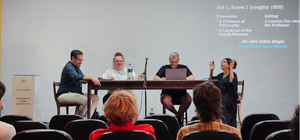
The Shifting Power team attended the annual conference of the American Society for Cybernetics (ASC) in Ouro Preto, Brazil from the 3rd – 7th of August 2026. This was a new community for our team, the home community of our long-time academic partner Ben (see our podcast “Computer Séance” and our symposium “After AI?”). Given what we understood about cybernetics – its highly interdisciplinary beginnings and creative scholarship – we decided to present some experimental thinking for our new fellowship work on Unlearning AI.
On Wednesday, August 5th, we presented a “paper in four voices” about our conceptual work on AI alignment via the concept of “Thought Collectives” (Ludwig Fleck, “Genesis and Development of a Scientific Fact”, 1935). This presentation covered our experiences with the Margate Queer AI Thought Collective, which brought together 6 queer artists and 6 queer AI researchers to investigate the potential for a queer AI. Over 2.5 days in Margate, Kent, the participants shared research practices from across their varied disciplines and then used some of these practices to generate “diegetic prototypes” (Kirby, 2009), narrative descriptions of AI tools that exist in a world of the participants’ speculation. This work highlighted to us how groups of people sharing key components of worldview imagine different tasks and configurations of AI than what is normatively understood as Artificial Intelligence.
In the presentation for ASC, we read reflexive pieces by the two organizers of the event, Dr. Tracie Farrell and visual/performance artist and filmmaker Liz Rosenfeld. We also invited two of our participants (AI researcher Dr. Aisling Third and writer Dr. Season Butler) to perform their prototype “Ursula”. All of the prototype presentations will be made available shortly through the Margate Queer Library and Archive via an interactive digital archive designed by visual and performance artist Aleks Slota. We concluded the presentation with a provocative reflection from performance artist and queer scholar Dr. Justin Hunt, who produced the event. To help ASC participants connect to this work, we framed our problem statement and queer intervention via Heinz von Foerster’s concept of stabilization, to explain how our understanding of AI has been narrowing over time and how we felt queer practice could disrupt and unsettle that process.
On Thursday, August 6th, we presented a table read of a text that is helping us to explore the potential of performance as a pedagogical support for creatives learning about AI, particularly when thinking about the impacts of geopolitics and power on innovation. The play, “Brain: A Play of the Whole Earth”, was written by Lionel Britton, a working-class playwright, in 1930. The play envisions a collective knowledge project controlled by workers, who obfuscate their progress from those in power and succeed in building a giant, mechanical Brain in the Sahara, which would do all the world’s thinking and problem solving. The play explores some common tensions around notions of individualism and collectivity, resistance and subjugation to power, and technosolutionism more generally. An arrangement of the play was developed by Dr. Justin Hunt, and performed by Dr. Brian Plüss, Dr. Aisling Third, Dr. Justin Hunt and Dr. Season Butler.
Latest News
Unlearning AI at ASC 2026: Queer futures, thought collectives and cybernetics
KMi brings human-centred AI perspectives to International Digital Education Forum
Advancing AI approaches to intangible cultural heritage at a British Academy workshop in Rome