
News Story
From Russia with love…
Thursday 23 Sep 2010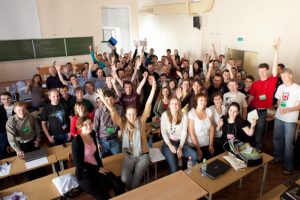
KMi Professor Stefan Rüger lectured on Multimedia Information Retrieval during a one-week Summer School at Voronezh State University, Russia. RuSSIR 2010 brought together postgraduate students from all over Russia and employees in the search engine industry.
Rüger’s course on multimedia information retrieval — spread over 5 days — discussed in detail the process of searching for and finding multimedia documents and how to build the best possible multimedia search engines. The intriguing bit with multimedia retrieval is that the query itself can be a multimedia excerpt, say, a picture. The Multimedia Information Retrieval course examined the full matrix of a variety of query modes versus document types. The interactive lectures discussed techniques and common approaches to facilitate multimedia search engines: metadata driven retrieval; piggyback text retrieval where automated processes create text surrogates for multimedia; automated image annotation; and content-based retrieval. The latter was studied in great depth looking at features and distances, and how to effectively combine them for retrieval. The last part of the course studied interactive ways of engaging with repositories through browsing and relevance feedback, roping in geographical context, and providing visual summaries for videos. The course emphasised state-of-the-art research in the area of multimedia information retrieval, which gives an indication of the research and development trends and, thereby, a glimpse of the future world.
Other lecture series were given during the RuSSIR 2010 week on Web Data Mining (Professor Ricardo Baeza-Yates, Yahoo Research), XML Information Retrieval (Professor Mounia Lalmas, University of Glasgow), Graph-based Methods for Social Search (Dr Alexander Troussov, IBM Ireland) and Distributed Information Retrieval (Professor Fabio Crestani and Dr Ilya Markov, University of Lugano) making the programme diverse and dense for every participant.
Sponsorship by Yandex, Google, HP, Microsoft Research, SKB Kontur and Rambler ensured that participants did not have to pay a fee for the summer school.
Related Links:
Latest News
From lab to standard: KMi research behind the new W3C Data Façades community group
Open University Researchers awarded £450,000 for “Unlearning AI”
Breadth vs Depth in an AI world: Rethinking graduate skills for 2036