Member
Alexander Mikroyannidis
Senior Research Fellow


 +44 (0)1908 652073

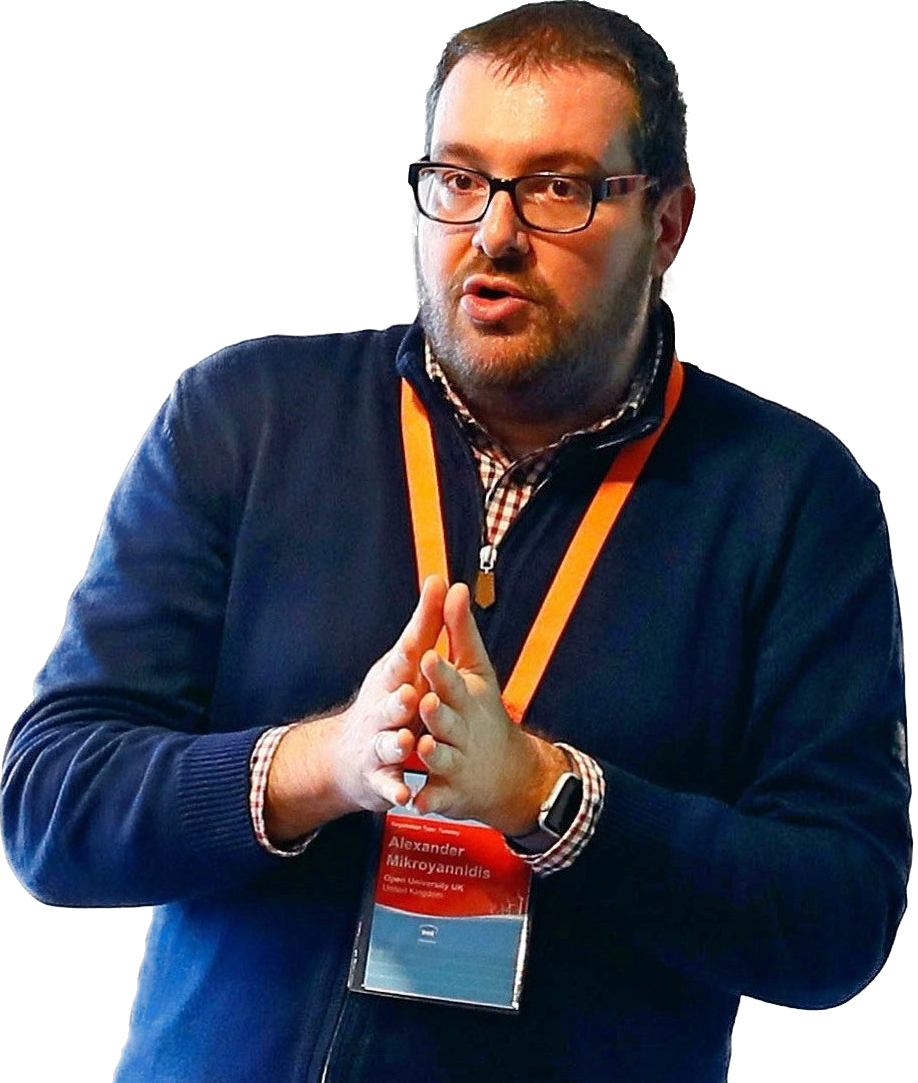


My research expertise is in the field of Technology-Enhanced Learning. I have been investigating the use of novel educational technologies for enhancing personalised learning, self-regulated learning, lifelong learning, as well as open education. I am currently exploring the responsible integration of Generative AI into online and distance education contexts for improving learner outcomes.
Keys: Technology-Enhanced Learning, Educational Technology, Open Education, Self-Regulated Learning, Personalised Learning, Lifelong Learning, Generative AI, Decentralisation, Blockchain
Projects
Technologies
News
21 Sep 2026
01 Sep 2026
28 Aug 2026
22 Jul 2026
10 Jul 2026
Publications
Mikroyannidis, A. (2026). Decentralised Online Learning. In: Fullwood, Chris; Branley-Bell, Dawn; Orchard, Lisa J.; Limniou, Maria and Stefanova, Vasilena eds. The Palgrave Encyclopedia of Cyberpsychology. Cham: Springer Nature Switzerland, pp. 1–5. https://oro.open.ac.uk/111577/.
Mikroyannidis, A. and Armakolas, S. (2026). Mind-Size Bites, Macro Impact: A Research-Based Framework for Experiential Learning in Online Microlearning Targeting Mental Health Counsellors. In: 20th International Technology, Education and Development Conference (INTED 2026), 2-4 Mar 2026, Valencia, Spain. https://oro.open.ac.uk/109147/.
Mikroyannidis, A., Kwarteng, J., Third, A., Domingue, J. and Tarrant, D. (2026). Learning with Responsible AI: Perceptions and Experiences of Learners in Online Professional Education. In: 20th International Technology, Education and Development Conference (INTED 2026), 2-4 Mar 2026, Valencia, Spain. https://oro.open.ac.uk/109149/.
Kwarteng, J., Third, A., Mikroyannidis, A., Tarrant, D. and Domingue, J. (2026). SAGE-RAI: Design Patterns for Transparent RAG Systems. In: The ACM Web Conference 2026 (WWW '26), 13-17 Apr 2026, Dubai, United Arab Emirates. https://oro.open.ac.uk/108348/.
Mikroyannidis, A., Perifanou, M. and Economides, A.A. (2025). Enhancing Language Learning with Generative AI: The Case of the OpenLang Network Platform. Computers, 14(12), https://oro.open.ac.uk/107547/.
Mikroyannidis, A., Domingue, J., Ekuban, A. and Kwarteng, J. (2025). AIDA: AI Digital Assistant for Personalised and Adaptive Online Learning. In: EdMedia + Innovate Learning 2025, 19-23 May 2025, Barcelona, Spain. https://oro.open.ac.uk/104371/.
Mikroyannidis, A. and Armakolas, S. (2025). Using Generative AI to Enhance Personalised and Self-Regulated Learning. In: EdMedia + Innovate Learning 2025, 19-23 May 2025, Barcelona, Spain. https://oro.open.ac.uk/103711/.
Mikroyannidis, A., Ekuban, A., Kwarteng, J. and Domingue, J. (2025). Best Practices for the Responsible Adoption of Generative AI in Higher Education. Proceedings, 114(1), pp. 1–8. https://oro.open.ac.uk/103123/.
Mikroyannidis, A., Third, A. and Domingue, J. (2024). Blockchain-based decentralised micro-accreditation for lifelong learning. Interactive Learning Environments, 33(3), pp. 2201–2215. https://oro.open.ac.uk/100059/.
Mikroyannidis, A., Domingue, J., Third, A., Tarrant, D. and Pieroni, T. (2024). Smart Assessment and Guided Education with Responsible AI. In: 20th International Conference on Intelligent Tutoring Systems (ITS 2024), 10-13 Jun 2024, Thessaloniki, Greece. https://oro.open.ac.uk/99051/.
Mikroyannidis, A., Sharma, N., Ekuban, A. and Domingue, J. (2024). Using Generative AI and ChatGPT for improving the production of distance learning materials. In: 2024 IEEE International Conference on Advanced Learning Technologies (ICALT), 01-04 Jul 2024, Nicosia, Cyprus. https://oro.open.ac.uk/97397/.
Mikroyannidis, A. and Armakolas, S. (2024). Decentralisation and Generative Artificial Intelligence in Higher Education. In: 12th International Conference in Open and Distance Learning (ICODL), 24-26 Nov 2023, Athens, Greece. https://oro.open.ac.uk/96474/.
Andrews, G., Balakrishna, C. and Mikroyannidis, A. (2023). The need for game-based learning methods to address cyber threats. In: 17th European Conference on Games Based Learning (ECGBL 2023), 5-6 Oct 2023, Enschede, Netherlands. https://oro.open.ac.uk/93435/.
Bozkurt, A., Gjelsvik, T., Adam, T., Asino, T.I., Atenas, J., Bali, M., Blomgren, C., Bond, M., Bonk, C.J., Brown, M., Burgos, D., Conrad, D., Costello, E., Cronin, C., Czerniewicz, L., Deepwell, M., Deimann, M., DeWaard, H.J., Dousay, T.A., Ebner, M., Farrow, R., Gil-Jaurena, I., Havemann, L., Inamorato, A., Irvine, V., Karunanayaka, S.P., Kerres, M., Lambert, S., Lee, K., Makoe, M., Marín, V.I., Mikroyannidis, A., Mishra, S., Naidu, S., Nascimbeni, F., Nichols, M., Olcott, D., Ossiannilsson, E., Otto, D., Padilla Rodriguez, B.C., Paskevicius, M., Roberts, V., Saleem, T., Schuwer, R., Sharma, R.C., Stewart, B., Stracke, C.M., Tait, A., Tlili, A., Ubachs, G., Weidlich, J., Weller, M., Xiao, J. and Zawacki-Richter, O. (2023). Openness in Education as a Praxis: From Individual Testimonials to Collective Voices. Open Praxis, 15(2), pp. 76–112. https://oro.open.ac.uk/91014/.
Mikroyannidis, A., Perifanou, M. and Economides, A.A. (2023). Developing a Sustainable Online Platform for Language Learning across Europe. Computers, 12(7), https://oro.open.ac.uk/90830/.
Mikroyannidis, A. (2022). The Role of Web 3. 0 and Blockchain in the Future of Education. In: Proceedings of 7th Panhellenic Scientific Conference "Integration and Use of ICT in the Educational Process", 16-18 Sep 2022, University of Patras, Greece. https://oro.open.ac.uk/85992/.
Salagianis, D., Salagianis, G., Armakolas, S. and Mikroyannidis, A. (2021). Blockchain technology in education and the new perspectives [H Τεχνολογία Blockchain στην εκπαίδευση και οι νέες προοπτικές]. In: 11th International Conference in Open and Distance Learning (ICODL), 26-28 Nov 2021, Athens, Greece. https://oro.open.ac.uk/83132/.
Salagianis, D., Salagianis, G., Armakolas, S. and Mikroyannidis, A. (2022). Blockchain technology in education: the future through the views of computer educators [H Τεχνολογία Blockchain στην εκπαίδευση: οι προοπτικές μέσα από την οπτική των εκπαιδευτικών πληροφορικής]. Educ@tional circle, 10(2), pp. 162–184. https://oro.open.ac.uk/83129/.
Farrell, T., Alani, H. and Mikroyannidis, A. (2022). Mediating learning with learning analytics technology: guidelines for practice. Teaching in Higher Education, 29(6), pp. 1500–1520. https://oro.open.ac.uk/83186/.
Mikroyannidis, A. (2021). Decentralising Education Using Blockchain Technology. In: Innovate Learning Summit 2021, 9-11 Nov 2021, Online. https://oro.open.ac.uk/81709/.