
architectures for scripted media objects project full details

Champion:
Trevor Collins
Senior Research Fellow


Participant(s):Peter Whalley, Jon Linney, Damian Dadswell
Timeline:02 Jul 2007
Share:
Architectures for scripted media objects
A partial solution to the reusability paradox
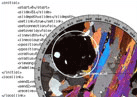
Developments in the underlying media technologies provide the potential for a new flexibility in the development of e-learning materials. It is now possible to create scripted media objects with a rich embedded pedagogy of expository structure and learner interaction.
The difference between scripted media objects and conventional multi-media resources is that they are designed to share parameters derived from their local context and to communicate with each other. This allows them to be customised by course authors within a simple web-based architecture and offers a potential solution to one of the major problems of open-source media reusability, how to create flexible media objects that are not pedagogically empty.
scripted media objects
- view all media as flexible, programmable objects, defined by external parameters for mode, configuration, overlay, position, text, etc
- configured initially by contextual control parameters and then dynamically
- communicate with other media objects and remote servers
provide
- malleable graphic representations and interactivity
- layered complexity allowing alternative levels of description
- shared communication between users
Related papers
http://weblab.open.ac.uk/related-papers/interaction_enquiry.pdf
http://weblab.open.ac.uk/related-papers/layered_media.pdf
Cena, F., Likavec, S. and Osborne, F. (2011). Propagating user interests in ontology-based user model. In: AI*IA 2011: XIIth Conference of the Italian Association for Artificial Intelligence "Artificial Intelligence Around Man and Beyond", 15-17 Sep 2011, Palermo, Italy. https://oro.open.ac.uk/40456/.
Cena, F., Likavec, S. and Osborne, F. (2012). Property-based interest propagation in ontology-based user model. In: 20th Conference on User Modeling, Adaptation, and Personalization-UMAP 2012, 16-20 Jul 2012, Montreal, Canada. https://oro.open.ac.uk/40455/.